Native bees lifecycles
To understand bees lifecycles we need to understand the different ways bees live.
Some live together, some live alone.
Some of them live in the ground or in deadwood or in hives.

Social vs Solitary

Social Bees
Social bees live in hives, have queens and make honey. Sometimes know as Eusocial. In Australia, there are 11 species of social bees. They have castes that do different jobs.
Queens: The job of the queen is to lay the eggs for the colony and create the next generation of bees.
Workers: The worker bees are female and will do all the jobs around the hive including cleaning, feeding the larvae and defending the colony.
Drones: Drones are male bees and their only job is to fertilise the eggs that the queen lays. They are kicked out of the hive shortly after they are done.
Solitary Bees
The majority of bees globally are solitary. This means they do not live in a hive with other bees and prefer to nest on their own in holes in the ground, deadwood, or masonry.
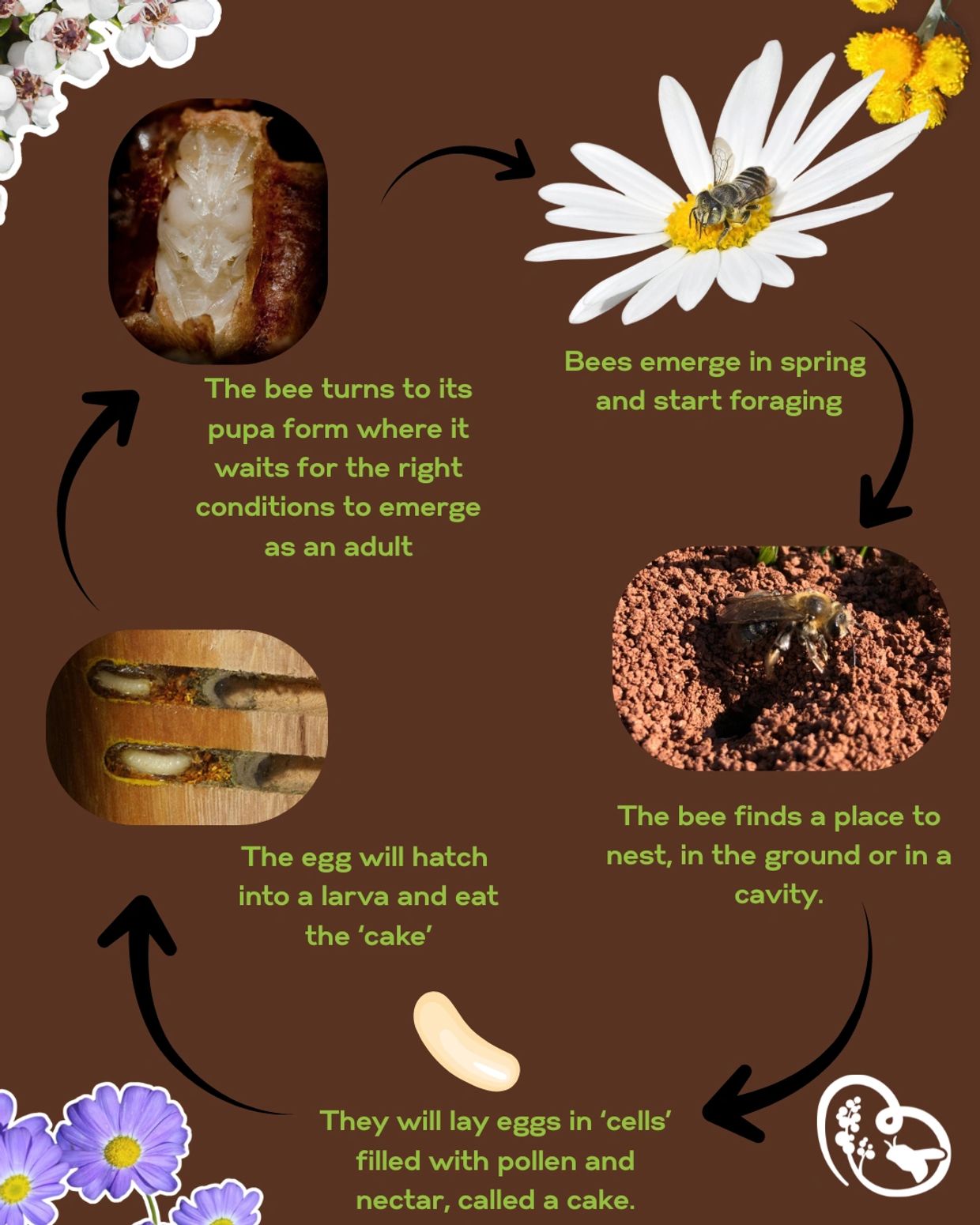
Above is a Megachile species also known as a leaf-cutter bee. They will often nest in holes in deadwood and create ‘cells’ in this hole by capping sections off with pieces of leaf.
Inside each section, the female will leave a ‘cake’ of pollen and nectar for the larvae to eat as they grow.
The female will lay multiple eggs in this hole and when the conditions are right (usually as the weather starts to warm) the young will emerge.
Communal Bees
Some species, like the Blue Banded bee, are not social but live in communities. They will tent their own young but will live near other bees, almost like an apartment block.
Often, many females share the same entrance to a nest that branches into individual tunnels, where the bees will lay eggs separately.
This set-up is beneficial as the nest entrance is very rarely left unguarded and the constant coming and going gives the bees extra protection from species like cuckoo bees.
Quasi-Social Bees
Quasisocial living occurs when several female bees emerge in the same nest after the mother has already left. Unlike communal bees, one sister becomes dominant, taking over the nest by repairing brood cells, building new ones, and laying eggs. The remaining sisters briefly help with foraging and nest maintenance before eventually leaving to establish nests of their own.
Because this arrangement is temporary and constantly changing, it can be difficult to pin down.
Unlike eusocial bees, which rely entirely on the colony, quasisocial bees retain the freedom to either cooperate or live independently. This short period of cooperation may help ensure at least one nest becomes well established before the others disperse.
Sub and Semi Social Bees
Semisocial bees
Semisocial bees show one of the earliest forms of labour division. Groups of sister bees share a nest, with some females laying eggs while others forage and help care for the brood. These roles are flexible, and bees eventually leave to establish nests of their own.
Subsocial bees
Subsocial bees are a step closer to true eusociality because mothers remain with and care for their offspring until they reach adulthood. The mother feeds, protects, and provisions her young, allowing different generations to briefly share the same nest. Many Australian small carpenter bees in the tribe Allodapini display this type of social behaviour.
The life cycle of a solitary bee
Different nesting behaviour
Ground nesters
Roughly 70% of bee species worldwide nest in the ground!
This is usually in sandy loose soil that is easy for the bees to excavate.
Ground-nesting bees have many different life cycles; some share their holes with others, while some are strictly solitary.
These bees require bare soil to complete their life cycles. They dig holes as safe places for their eggs to develop into larvae.
Nesting in deadwood
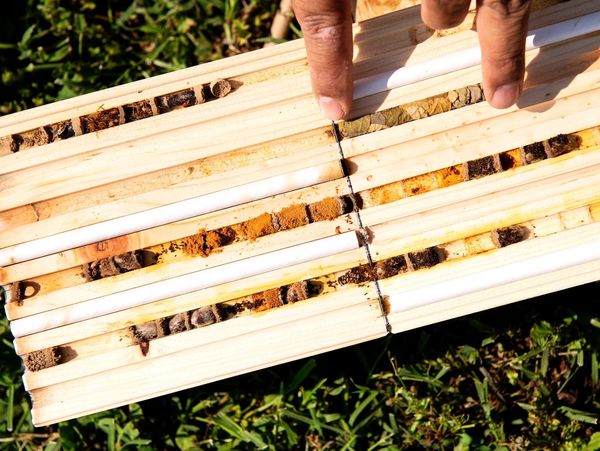
Around 1/4 of bees nest in cavities in dead wood or the stems of plants.
On the left, you can see the cells that cavity-nesting bees make. The top cell is made by resin bees and has been capped with mud.
The next cell down has been used by a leaf-cutter bee (Megachile sp.). They cut circular pieces of leaf and make similar cells to resin bees.
There are so many other amazing ways bees make these cells from mud, clay, and even flower petals.
Hives
In Australia there are 11 species of native bee that nest in hives. These are from genus Tetragonula and Austroplebeia and they are know as stingless bees
They do produce honey but it is very different from the honey you get in the shops and people describe it as tangy.
Stingless bees are a varied and interesting group. Find out more about them here.
Novel nests
Some bees have very interesting nesting behaviour.
The Blue Banded bee typically nests in clay soils but often makes its home in holes in masonry. Showing that bees can make homes in unlikely places.
The Red-tailed mason bee (Osmia bicolor) in the UK, nests in old snail shells and covers them with piles of sticks to hide them from predators.