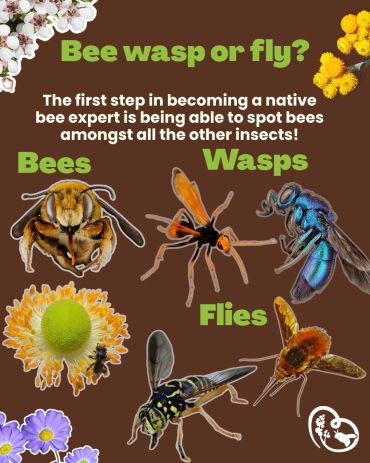
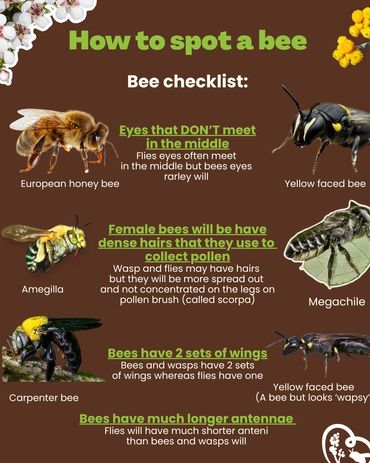
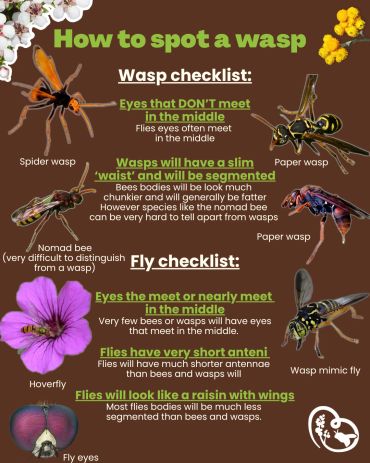
Is it even a bee?
Native Stingless Bee
Native Stingless Bee
Native Stingless Bee

11 species of social stingless bees are native to Australia, and they are the ONLY Aussie species that are social, meaning they live in hives, mostly in trees, and make honey (Scientific names: Tetragonula and Austroplebeia).
They are very small roughly 2-4mm in size and don’t have a stinger, but can give you a nasty bite!
The honey they produce is very different to European bees and has a distinctive flavour.
Blue Banded Bee
Native Stingless Bee
Native Stingless Bee
The Blue Banded Bee (Amegilla sp) is one of the most charismatic species in the world and they live here in Australia.
They are solitary and nest in holes in masonry or the ground with the males ‘roosting’ on branches as they sleep, shown above. Sometimes they will share nesting sites.
Inside a hole, the females will lay an egg in a wax cap that will contain pollen and nectar. The egg hatches into a larva which will eat the mixture and then turn into a pupa before emerging as an adult bee!
Carpenter Bee
Native Stingless Bee
Carpenter Bee
The Great Carpenter Bee (Xylocopa aruana) is the largest species of bee in Australia, nearly 10x the size of a stingless bee.
They are solitary and nest in deadwood and have a similar life cycle to blue banded bees.
Male and female carpenter bees look very different which is similar to many other species of bee worldwide. Females have a black abdomen and yellow thorax as pictured above, whereas males are golden or pale brown all over.
Invasive bees
Invasive bees
Carpenter Bee
This is a European Honey Bee (Apis Melliferna).
They are invasive in this county and compete with native bees for pollen and nectar. They are common in urban areas and are especially hardy, meaning they can survive harsh conditions that native species cannot. They are also generalists and will forage on many different species of flowers, whereas some native bees may be reliant on one host plant.
In Tasmania, the invasive Bubble bee (Bombus sp) has also established but has not reached the mainland.
Wasps
Invasive bees
Hoverflies
Wasps are also pollinators and there are over 12,000 species in Australia! They are related to bees (both in the order Hymenoptera) but often feed on other insects rather than the vegetarian diet of bees.
Because of their diet, they don’t have as many hairs on their body called a pollen brush in bees), as they are not collecting pollen from flowers. They are also often more slender than bees and have a thin ‘waist’, which is key in telling the difference between the two.
Wasps are often overlooked and seen as pests but they are crucial for pollination and for controlling other insect populations.
Hoverflies
Invasive bees
Hoverflies
There are roughly 160 species of hover flies or flower flies in Australia. They have evolved to look like bees and wasps to deter would be predators by making them believe they have a stinger. But don't overlook them as they are crucial pollinators!
Hover flies can be distinguished from bees by:
- Their big bungling eyes that meet in the middle.
- They will have 2 wings whereas bees and wasps will have 4.
- Their body will be less segmented than that of bees and wasps.
- Bees will have large antenna but flys will be short like the picture above.
Bee wasp or fly?